Highlights
- Keep well watered
- Make sure the pot has drainage
- Do not remove cable ties
- Pinch new growth off the trunk
- Use Loam Soil for potting up
- Use Water Retaining Granules
- Spray with fungicide monthly
- Feed from March up to June
- Do not trim after Late July before Winter
- Leave outside all year round (Full Hardy)
- Lifespan up to 25 years
Important
Market Willow Twist Purchase: Make sure to keep your Willow Twist well watered. Please follow the directions below for Potting Up with regard to Loam Soil and Water Retaining Granules.
Posted Willow Twist: If you have received a posted Willow Twist via our Order Form, please place the bottom 15cm of the Willow Twist in water ASAP after delivery, and pot up within a couple of weeks.
During Very Warm Weather: If you are concerned about your Willow Twist drying out, you can place the pot in water. However, you must change that water every 3 to 5 days to avoid bacterial root rot.
Disease Prevention: To keep your Willow Twist free from disease, we recommend that it is sprayed monthly with a preventative and curative solution such as Provanto Fungus Fighter Plus.
Introduction
To keep your Willow Twist in good health, its very important that they are kept well watered (potentially daily in very warm weather).
However, the use of Loam Soil and Water Retaining Granules can reduce the frequency of watering required by up to four times.
Cable Ties are used to secure the willow whips in their decorative design. Do not remove the ties, as the willow whips will unfurl. In general, the ties should not restrict growth, but more details about that are below in the FAQ.
To keep the visual effect of the twisted trunk of the Willow Twist, when new growth appears, simply use your fingers and pinch it off.
Do this as promptly as possible before the growth toughens up and is harder to remove without damaging the bark.

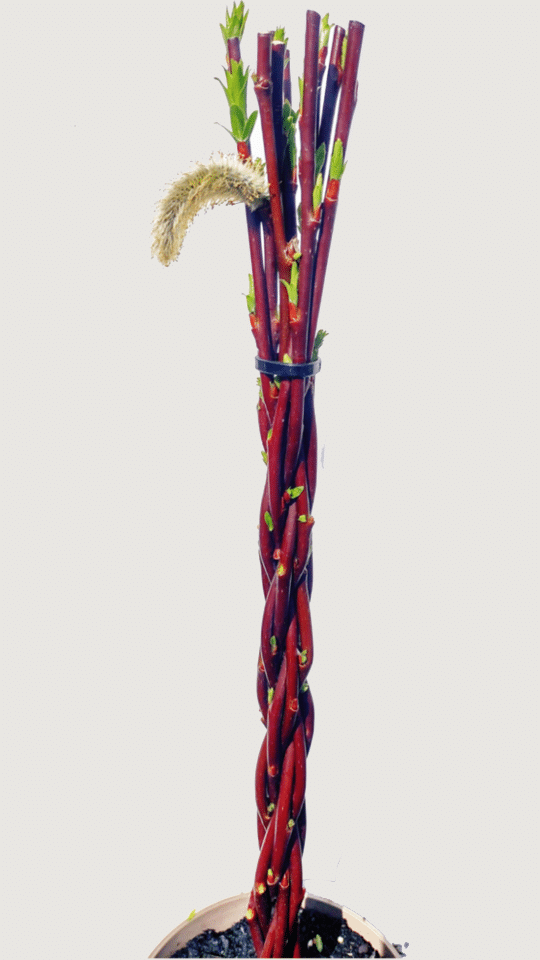
After a couple of years, the twisted living willow whips will bond together. This process is called Pressure Grafting. At this point, it doesn’t matter that the cable tie may snap off; the Willow Twist will hold its form.
Over the years, the diameter of the twisted decorative trunk will gradually increase while maintaining its design, though it will lose its violet colour, and take on an aged bark appearance.
The most important thing is that the Willow Twist must not dry out.
During very warm weather you can place the Willow Twist pot into a bucket/tray of water. However, you must change that water every 3 to 5 days to avoid bacterial build up in the water which can lead to root rot.
The Willow Twist will grow in partial shade to full sun. It must be kept outdoors all year round and will cope with severe frost (full hardy).
Planting & Potting Up
Its very important that you do not remove the ties that hold the Willow Twist in its decorative design.
Recommended planting depth is roughly 15cm.
When planting in the ground, keep the Willow Twist at least 1m away from any walls and the eaves of any roof structures to ensure the Willow Twist receives enough light and rain.
Make sure you firm the soil around the Willow Twist. Don’t worry about over-compacting the soil, the roots will do just fine.
As long as the Willow Twist crown is kept trimmed as per the instructions below, there will be no risk of root damage to drains/structures.
Pot Size & Drainage
When it comes to choosing a pot, imagine how big you want the crown of the Willow Twist to ultimately be/maintained at.
The size of the Willow Twist crown and root ball needs to be at least a 1:1 ratio.
Therefore, choose a pot size that will accommodate a root system of an equivalent size to the projected crown size of your mature Willow Twist.
A taller pot will also help to display the twisted trunk design of your Willow Twist at a more visible height to really show it off.
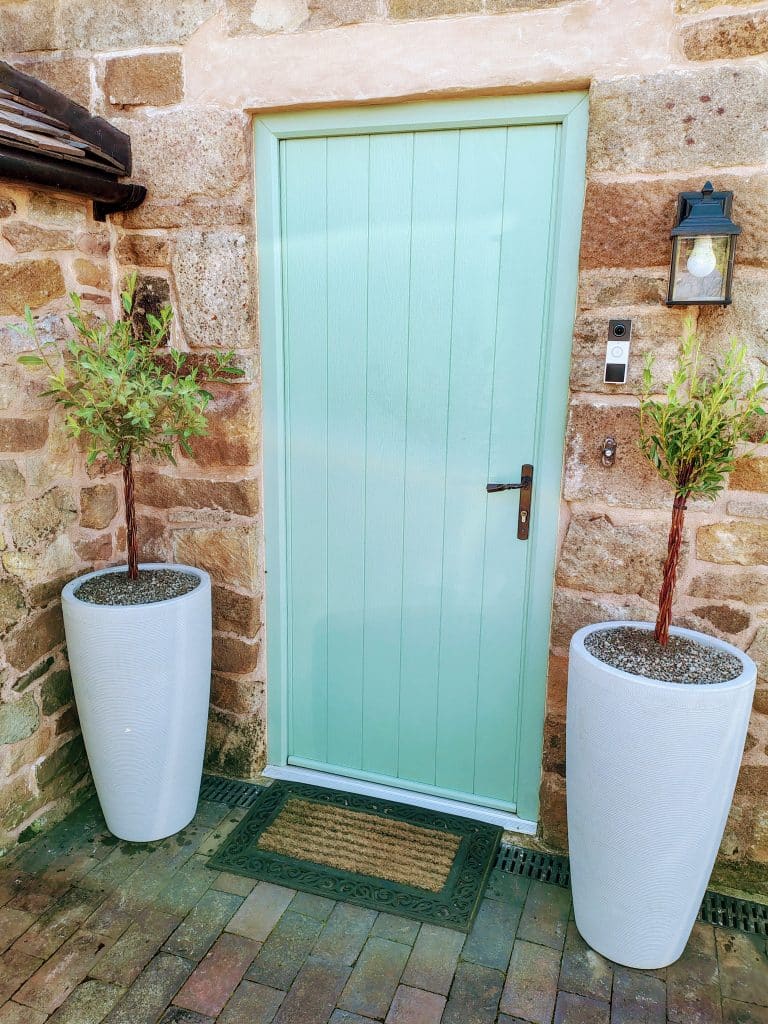
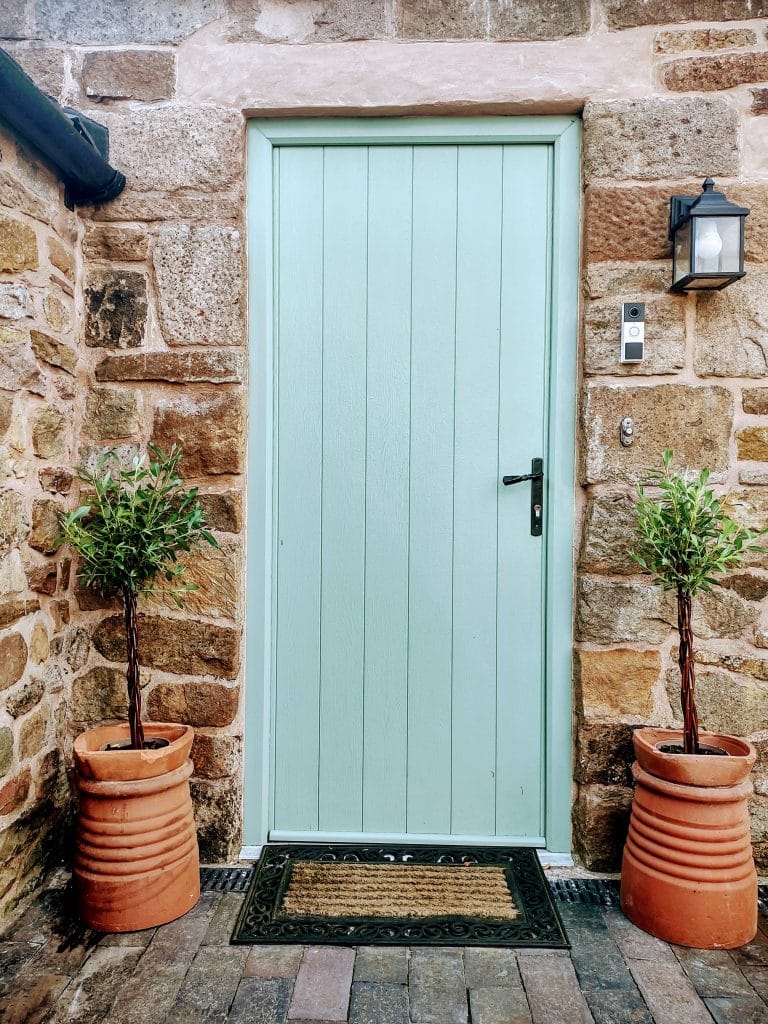
Larger/taller pots are also recommended for those who have a pair of Willow Twists and wish to ultimately grow them into an arch over a doorway.


A new Willow Twist, after around 2-3 months, will have established a root system and will, therefore, need less attention with regard to watering.
This is particularly true with a sufficiently large pot filled with Loam Soil and a sufficient amount of Water Retaining Granules.
Drainage & Avoiding Stagnant Water
With regards to drainage and holes in the pot, you want to avoid standing/stagnant water in the pot to reduce Anthracnose issues (more details below).
By using Loam Soil and Water Retaining Granules, how frequently you have to water your Willow Twist can be greatly reduced.
During very warm weather you can place the Willow Twist pot into a bucket/tray of water. However, you must change that water every 3 to 5 days to avoid bacterial build up in the water which can lead to root rot.
However, I cannot stress this enough, do not let the Willow Twist dry out.
Loam Soil
To fill up your pot, use a good quality compost or, ideally, a loam-based topsoil such as the examples below, as loam soil holds onto moisture/nutrients well due to its clay content.
You’ll also see it sold as John Innes No. 3 Compost.
If you repot your Willow Twist in the future to a larger pot, first trim the crown down, as you will likely have to trim the root ball to get it out of the pot.


Water Retaining Granules
Willow Twists that we bring to market in 2L pots contain a mixture of Loam Soil and Water Retaining Granules, sometimes referred to as Rain Gel.
They are a “Super-Absorbent Polymer” (SAP), designed to act like a microscopic sponge.
Therefore, when the Willow Twist is watered, it holds onto more moisture inside the pot. Keeping the Willow Twist happy 😊.
Water-retaining granules hold 150 to 400 times their own weight in water.
This has major benefits during the warmer months of the year, keeping the Willow Twist happy in a moist pot of soil and reducing the frequency of watering required.


When you’re potting up your Willow Twist into a larger pot, I would very much encourage you to consider mixing in some of these water-retaining crystals.
How much of these water-retaining crystals will you need? Well, for a 2L pot, we add 5g of these water-retaining crystals.
The general rule of thumb is 2.5g of water crystals per litre of soil.
However, if you are concerned about watering frequency or simply forgetting to water your Willow Twist, adding more is worth considering.
If you watch the video above, ideally mix in the water retaining granules with the loam soil when potting up your Willow Twist.
In terms of lifespan, the water-retaining granules can be effective for up to 5 years.
When you feel your pot is not holding onto moisture as well as it did, follow the advice in the video above. It shows how you can add more water-retaining crystals to your pot.
During very warm weather you can place the Willow Twist pot into a bucket/tray of water. However, you must change that water every 3 to 5 days to avoid bacterial build up in the water which can lead to root rot.
Feeding
When planting/potting up your Willow Twist, adding some slow-release general-purpose granular feed is advisable.
Adding a fertiliser will help to develop root growth and develop a strong/healthy crown. It can also help the Willow Twist to fight off infections.
Look for products that state they are a ‘balanced feed’, typically stated as 7-7-7 or 10-10-10. These numbers relate to the nutrients, namely, Nitrogen, Phosphorus, and Potassium.


Granular feed, such as the options above, provides one of the simplest and easiest solutions to feed your Willow Twist as they have a blend perfectly suited to trees & shrubs and will release feed slowly over time.
Feeding Frequency
- Early Spring (March/April): Apply your main balanced feed to support early-season growth.
- Late Spring (May): A secondary light feeding can be applied.
- Mid-June (Final Application): Stop all feeding by mid-June to allow the tree’s nutrient levels to stabilise before the catkin initiation window in July.
Do not feed after June, as this could inhibit the production of catkins, which start to develop in mid to late July.
You will have to adjust the amount of feed relative to the capacity of the pot you’re using; larger pots will obviously need more feed. Please follow the recommendations on the packaging.
To give your Willow Twist an additional health boost, you could consider additional feeding with some Magnesium (Epsom Salt), which supports photosynthesis and counters yellowing leaves.
As Potassium plays such an important role in plant health, including helping to fight off fungal infections, you may want to consider a dedicated potassium fertiliser such as the example below.
With a liquid potassium concentrate, just 5ml is mixed per litre of water via sprayer or watering can with around a small cups worth applied once a week.


Trimming
As the Willow Twist starts to grow, buds will appear all over the tree. Growth above the cable tie will form the crown of the Willow Twist topiary.
The growth that appears below the cable tie on the trunk/stem will need to be pinched off with your fingers to maintain the decorative effect/design.
By the second growing season, buds on the trunk/stem will be less frequent.
If you don’t promptly pinch off the new growth and it is allowed to grow longer, you may not be able to pinch it off with your fingers, and you may need to cut it off with secateurs/scissors, which will not leave the best effect.
First Year Willow Twists:
- Avoid trimming a new/first year Willow Twist where possible, as it helps the plant to grow a root ball faster for stronger plant growth in subsequent years, and it also improves the disease resilience of the Willow Twist.
Second Year Willow Twists Onwards:
- After the catkin display in March, give your Willow Twist its first cut back of the year, ready for that year’s new growth.
- The Spring cutback can be quite low into the crown, but do not cut into the hardwood stems that are part of the original Willow Twist structure.
- Second year onwards, the Willow Twist will grow much faster than in its first year. Therefore, trim to suit your intended shape.
- Trimming between one to four times a year is typical.

Important:
- Never cut into the hardwood stems that form the base of the crown.
- Don’t trim after late July/August, as you may cut off developing catkin buds, which would flower in early Spring with attractive, fluffy silver catkins.
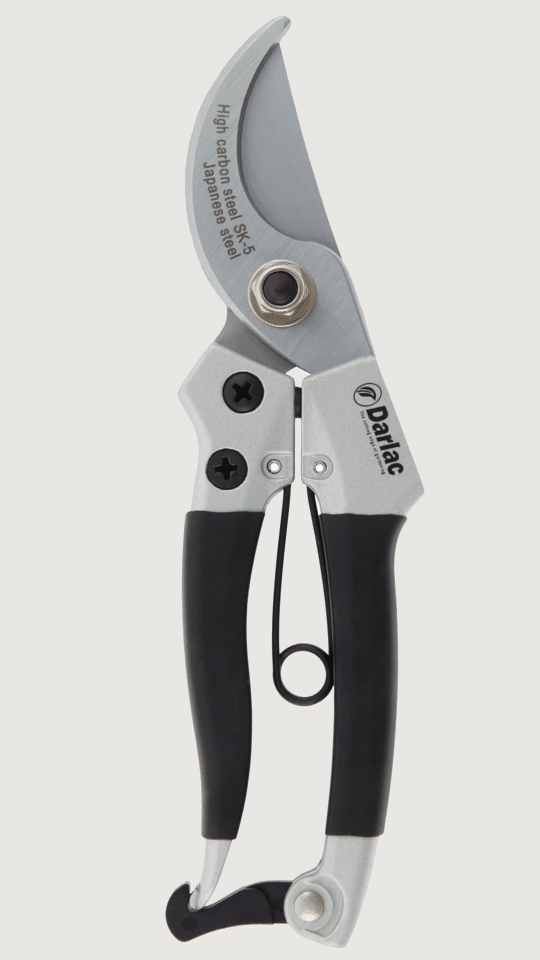
- After trimming, its recommended to give the tips of the Willow Twist leaves a quick spray with fungicide to keep disease at bay. More details below.
Pests & Diseases
Willow is generally very resistant to pests and diseases. However, all plants have pests and diseases to be aware of:
Anthracnose
Willow will happily grow in very wet conditions, even in standing water. Unfortunately, that’s also the environment Anthracnose is happy to grow in.
Anthracnose is an airborne fungal infection which can cause leaf and stem dieback if not promptly addressed with fungicide (see below). Pot drainage is also required to help to avoid the environment for Anthracnose.
Signs of Anthracnose are yellowing leaves, which start to dry up and drop off, along with black lesions on the stems of the willow.
First year Willow Twists in early to late Spring (March to June) can be susceptible as the fungus likes the mild wet weather and the young tender leaves.
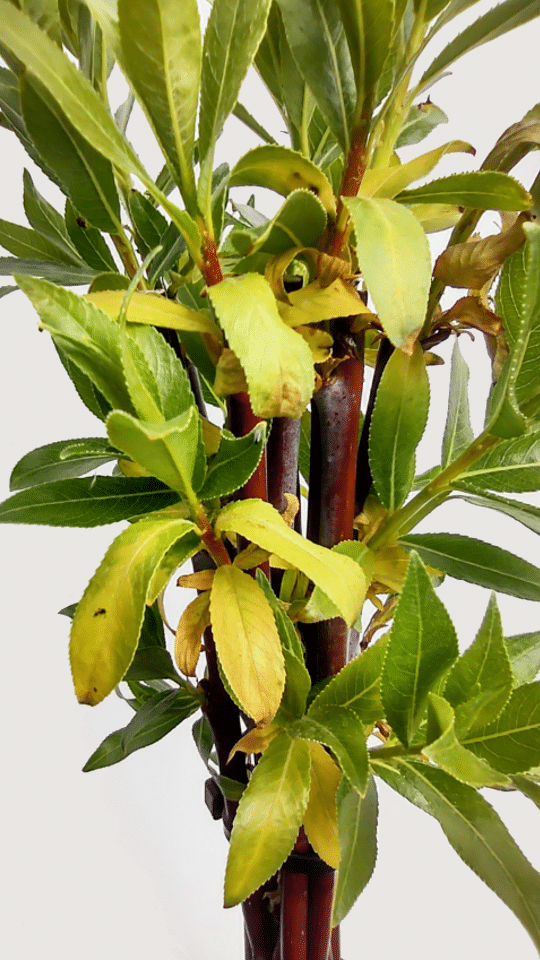
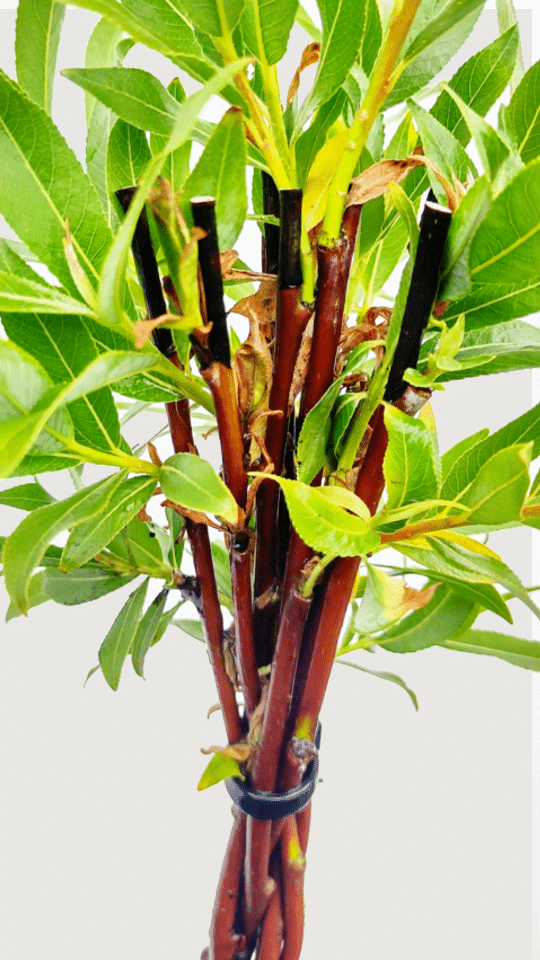
As the months get warmer and drier, and from year two onwards, a Willow Twist is much more resistant to fungal infections
The older/more mature a Willow Twist gets, the more resilient it becomes to airborne fungal infections due to its waxy/sturdier leaves.
While the Willow Twist will happily grow in a wet environment, unfortunately, so will Anthracnose. This is why we recommend the use of a pot with holes to avoid stagnant pools of water.
However, proper drainage along with Loam Soil and Water-Retaining Granules will create a moist soil for the Willow Twist, but not create an environment for the Anthracnose to thrive.
Steps To Address An Anthracnose Infection
- Check pot drainage to avoid stagnant water.
- Pick off any yellow, brown or generally unhealthy leaves and dispose of them in the bin to avoid future contamination.
- Spray with fungicide
- Making sure to spray under the leaves, as the Anthracnose fungus likes to penetrate the leaves through the stomata, which are how the leaves breathe.
As a preventative measure the Willow Twist should be sprayed with fungicide monthly during the growing season, especially during its first year.
If you believe your Willow Twist is experiencing a fungal infection, after picking off and disposing of the yellow leaves, spray with fungicide weekly until the Willow Twist returns to health.
Make sure you review the information on feeding the Willow Twist to give it the best chance to fight off fungal infections by keeping it as healthy as possible.
Important
Furthermore, avoid trimming a first Willow Twist where possible, as in its first year, letting the Willow Twist grow longer/thicker stems makes it much more resilient to an Anthracnose infection.
Fungicide Spray
To keep your Willow Twist free from disease, we recommend that it is sprayed monthly with a preventative and curative solution such as Provanto Fungus Fighter Plus.
However, if you believe your Willow Twist is currently experiencing an Anthracnose infection or another fungal infection/disease, its recommend to spray weekly until the Willow Twist returns to health.
Important:
- Make sure to spray under the leaves, as the Anthracnose fungus likes to penetrate the leaves through the stomata, which are how the leaves breathe.
- Spray in the Morning/Evening to avoid leaf burn.


FAQ
Q: What type of willow are the Willow Twists made from?
We grow and make our products from Violet Willow (Salix Daphnoides).
Q: How do you make your Willow Twists?
Nine willow whips are specifically selected and they are then hand woven/twisted together simultaneously in both a clockwise and anti-clockwise direction.
Its difficult to explain (and even more difficult to do), but as I’m sure you’ll agree, the effect is very attractive.
Q: When do you make your Willow Twists?
Our Willow Twist production window is between November to March, after leaf drop and while the willow is dormant.
During this production window, we send out orders via the post. Learn more on our Order Page.
Q: Is a Willow Twist a suitable Christmas gift?
Of course! The Willow Twist can serve as an excellent and unique Christmas gift to a loved one/friend when placed in a decorative pot.
Please note, so I can get orders out ready for Christmas, please complete the Order Form before the start of December.
Q: Can the Willow Twist be kept indoors?
No, the Willow Twist needs to be kept outdoors all year round. They are full hardy and cope with any cold UK weather.
Q: I’ve ordered some Willow Twists through the post. What do I do now?
As soon as your Willow Twists arrive, remove the plastic bags covering the ends of the Willow Twists and place the bottom 15cm in water ASAP.
Then, ideally, you’ll get them potted up into their pot/ground area within a couple of weeks, ready for their first signs of growth in March.
It’s then simply a case of following the rest of the plant care information above.
If you have given the Willow Twists as a gift to someone, make sure to make them aware of the plant care information on this website.
Q: What size of plant pot for a Willow Twist?
The general rule is that the width of the pot should match the width of the crown you wish to grow.
So, as the Willow Twist grows, it may need a larger pot. A larger pot can also mean that less frequent watering is required.
Imagine how large you want the crown of your mature Willow Twist to be/maintained to.
Then choose a suitable pot that can accommodate a root ball to crown size ratio of 1:1. This could avoid the need for future potting up.
Q: How deep should a Willow Twist be planted?
The bottom 15cm of the Willow Twist should be in the soil/compost. It’s also very important to compress the soil/compost around the twisted trunk.
Q: How often should a Willow Twist be watered?
You want to make sure the loam soil in the pot is always moist. The water-retaining granules that we add to the soil will help the pot to hold moisture.
A larger pot that can hold more water in its soil, which will reduce the frequency of watering required.
When potting up, we strongly recommend you use loam soil and water-retaining granules.
You do not need to worry about over-watering, but some pot drainage is recommended to avoid root rot and Anthracnose issues.
During very warm weather you can place the Willow Twist pot into a bucket/tray of water. However, you must change that water every 3 to 5 days to avoid bacterial build up in the water which can lead to root rot.
Q: Can I use a pot with no holes to hold more water?
Unfortunately, this is not recommended.
While the Willow Twist will happily grow in a fully saturated pot with water at the base of the tree, its also the ideal environment for Anthracnose.
Therefore, the recommendation is for a pot with drainage filled with loam soil and water-retaining granules to provide moist but not fully saturated soil.
This way, you can keep your Willow Twist happy without creating a breeding ground for Anthracnose, as it cannot grow in the soil.
Q: How often should a Willow Twist be trimmed?
Avoid trimming a new/first-year Willow Twist so it can focus on growing a strong root ball and a more resilient plant than a thicker crown.
From Year 2 onwards, trimming the fresh growth as part of the crown will encourage even more growth.
The general recommendation is trimming between one to four trims per season, with more trimming creating a denser topiary effect.
However, don’t trim between late July and Winter. More details here.
Each Spring, after the catkin display, the Willow Twist should be trimmed back, ready for the upcoming growth of that season.
Q: How do I repot a Willow Twist in the future?
For a first-year Willow Twist, simply lift the root ball as a whole out of its 2 Litre pot and place it into your larger pot filled with Loam Soil and Water Retaining Granules.
Year two onwards, if you do need to repot a Willow Twist later in its life into a larger pot, the first step is to trim the crown of the Willow Twist down, as you will likely have to trim the root ball to get it out of its current pot.
Trimming down the crown of the Willow Twist means its far less likely to experience die back/stress/leaf drop moving from one pot to another.
Q: Will the decorative effect of the stem/truck get any taller?
No, while the decorative stem/trunk will get thicker and fuse together over the years (pressure graft), the decorative effect will not continue to get taller.
Q: Does a Willow Twist require a spot with full sun?
No, a Willow Twist will quite happily grow in an area with partial shade. However, it won’t grow well in an area with very little light/permanent shade.
Q: The leaves have turned yellow and dropped off?
Water stress (lack of water) is the most likely reason. Especially if you can see the rest of the leaves on the plant drooping.
Also, in the Summer months (from July onwards) its normal for Willows to drop some of the lower leaves on their stems.
If you are struggling to water the Willow Twist frequently enough, you may want to add more Water-Retaining Granules to your pot.
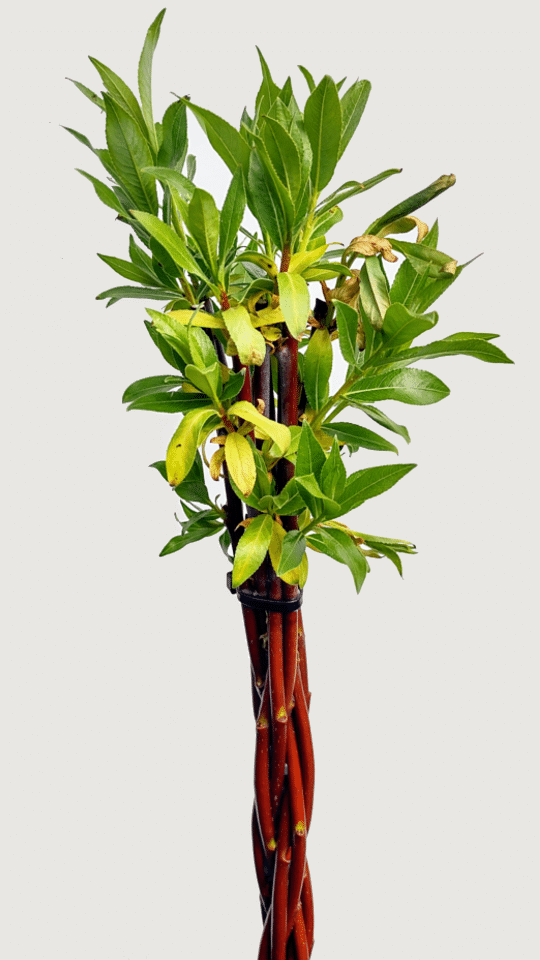
However, presuming you have kept the Willow Twist well watered, yellow leaves could also be a sign of Rust or Anthracnose/Black Canker.
Rust is a fungal infection, and it looks like yellow spots on the leaves. It commonly appears in the Summer months. It does not harm the plant and can be corrected with a fungicide application under the leaves.
Anthracnose is a fungal infection that is carried in the air. First year Willow Twists in early to late Spring (March to June) can be susceptible as the fungus likes the mild wet weather and the young tender leaves.
This is why we recommend the use of a pot with holes to avoid stagnant pools of water. Pot drainage, loam soil and water-retaining granules will create a moist soil for the Willow Twist, but not an environment for the Anthracnose to thrive.
It’s also why we don’t recommend trimming a new/first year Willow Twist during its first growing season.
As the months get warmer and drier, and from year two onwards, the Willow Twist is much more resistant to fungal infections due to its waxy/sturdier leaves.
Steps To Address An Anthracnose Infection
- Check pot drainage to avoid stagnant water.
- Pick off any yellow, brown or generally unhealthy leaves and dispose of them in the bin to avoid future contamination.
- Spray with fungicide
- Making sure to spray under the leaves, as the Anthracnose fungus likes to penetrate the leaves through the stomata, which are how the leaves breathe.
As a preventative measure, the Willow Twist should be sprayed with fungicide monthly during the growing season, especially during its first year.
If you believe your Willow Twist is experiencing a fungal infection, after picking off and disposing of the yellow leaves, spray with fungicide weekly until the Willow Twist returns to health.
Make sure you review the information on feeding the Willow Twist to give it the best chance to fight off fungal infections by keeping it as healthy as possible.
Q: Why are the stems turning black?
If you can see black on the stems of the Willow Twist, this is a sign of Anthracnose/Black Canker, which is a fungal infection.
Now, as long as the each of the nine stems of the Willow Twist can establish a strong new stem before the fungal infection reaches it, in most cases, the rising sap (water/nutrients) will stop the downward travel of the infection.
However, you still want to spray these black stems with fungicide to kill the fungus to stop it from producing more spores to infect more leaves.
IMPORTANT:
- As a preventative and curative solution we recommend spraying your Willow Twist monthly during the growing season with Provanto Fungus Fighter Plus.
- Making sure to spray under the leaves, as the Anthracnose fungus likes to penetrate the leaves through the stomata, which are how the leaves breathe.
- Spray in the morning/evening to avoid leaf burn.
Q: Should the cable tie ever be cut off?
As I’ve stated at the start of the page, its very important that the cable tie is left on for at least the first couple of years of the Willow Twists’ life before the nine stems pressure graft together.
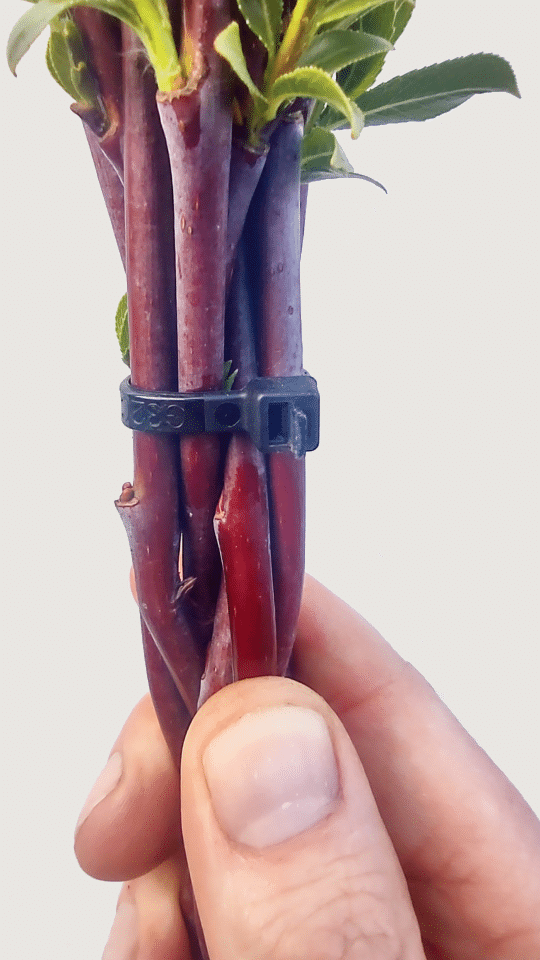
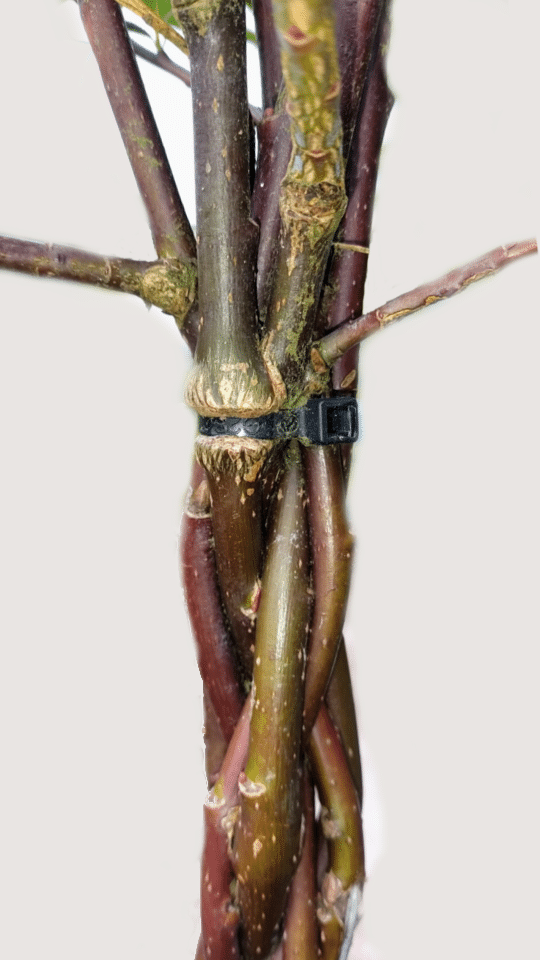
However, in the continuing years, you may wish to cut off the original cable tie and add an adjustable cable tie if you think it’s restricting growth as the stems get thicker.
Importantly though, before you cut the existing cable tie, have a firm grip on the Willow Twist to hold its shape while you secure the new adjustable cable tie.
Q: When do the catkins appear?
In late Winter/early Spring (typically the start of March) is when the catkins may appear before new growth.
They will appear at the ends of the newest growth. For instance, below are catkins on a new Willow Twist.
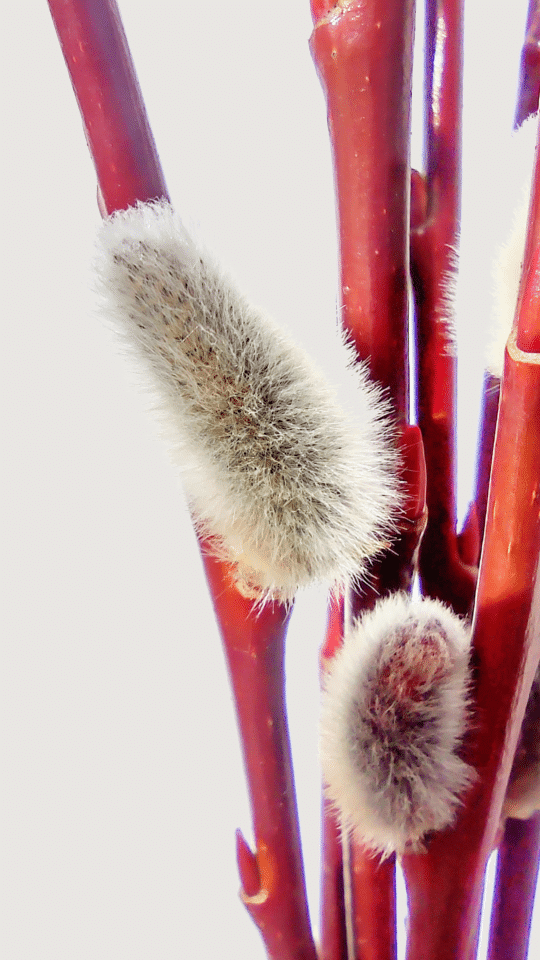
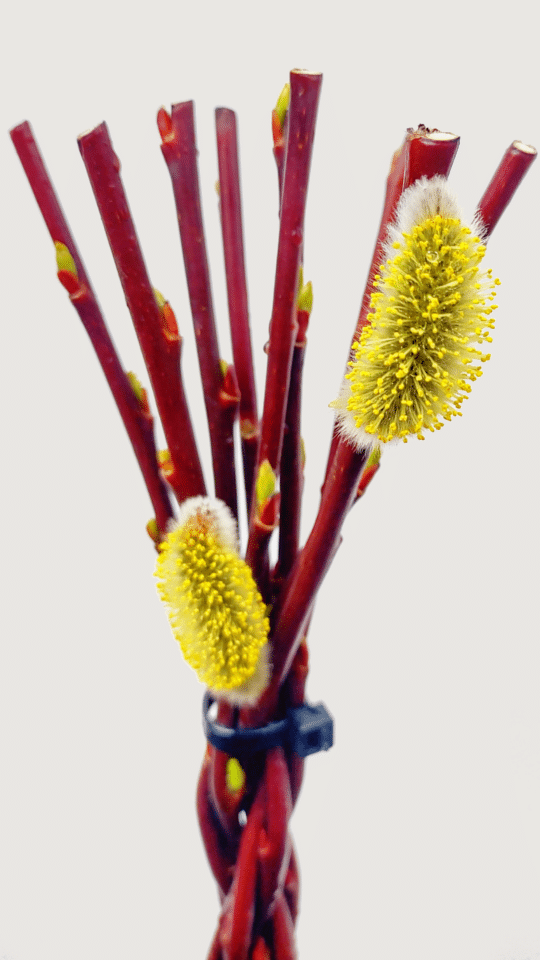
However, don’t be surprised if you don’t see any catkins appear on the first one to two years of new growth on a Willow Twist, that’s normal.
For its first couple of years of life, the Willow Twist may focus on developing a thicker crown/root development before putting energy into catkin production.
Q: Do I need to remove new buds on the decorative trunk/stem?
Yes, if you don’t, that new growth will eventually cover up the decorative effect of the twisted trunk.
They are easy to pinch off when they are around 1cm in length. During the second growing season, they will be very minimal.
Q: What is Bloom and how to deal with it?
Bloom may appear on the twisted trunk of the Willow Twist and its completely natural and normal, its not a bacterial/fungal infection.
It’s a waxy coating produced by the Willow as a means of protection to reduce moisture loss, the same as bloom on grapes.
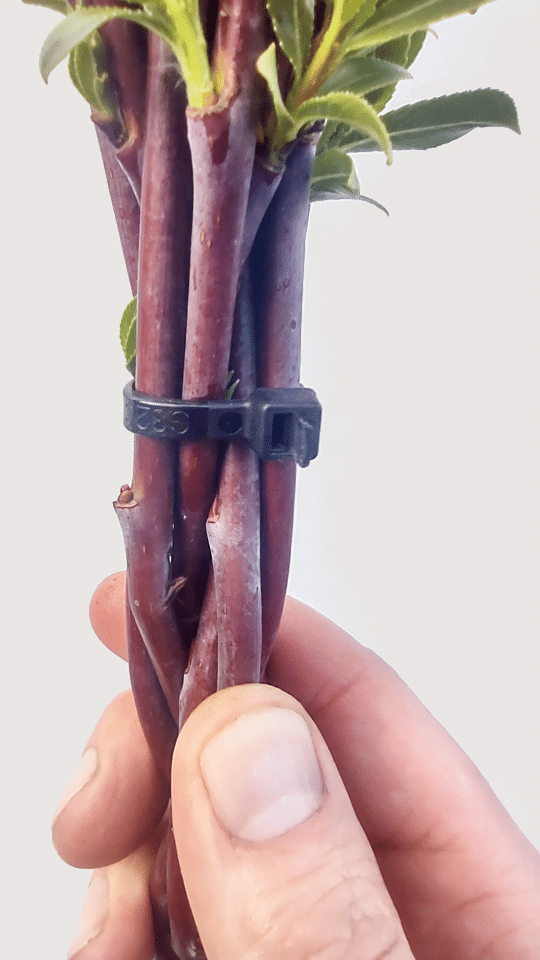
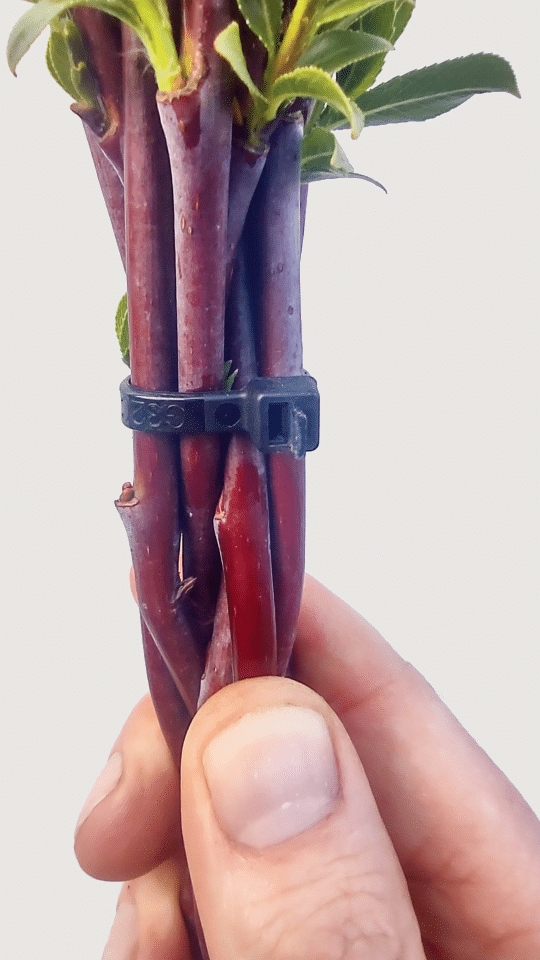
However, if you would like to remove it from the Willow Twist its easy to do as you can see from the image above where I rub my thumb over it.
The most practical means to remove bloom is with a soft brush/paint brush and some water, you can wash it off in seconds.
Q: When to do the first trim?
First Year Willow Twists:
- Avoid trimming a new/first year Willow Twist where possible, as it helps the plant to grow a root ball faster for stronger plant growth in subsequent years, and it also improves the disease resilience of the Willow Twist.
Second Year Willow Twists Onwards:
- After the catkin display in March, give your Willow Twist its first cut back of the year, ready for that year’s new growth.
- The Spring cutback can be quite low into the crown, but do not cut into the hardwood stems that are part of the original Willow Twist structure.
- Second year onwards, the Willow Twist will grow much faster than in its first year. Therefore, trim to suit your intended shape.
- Trimming between one to four times a year is typical.
Important:
- Never cut into the hardwood stems that form the base of the crown.
- Don’t trim after late July/August, as you may cut off developing catkin buds, which would flower in early Spring with attractive, fluffy silver catkins.
- After trimming, its recommended to give the tips of the Willow Twist leaves a quick spray with fungicide to keep disease at bay. More details below.